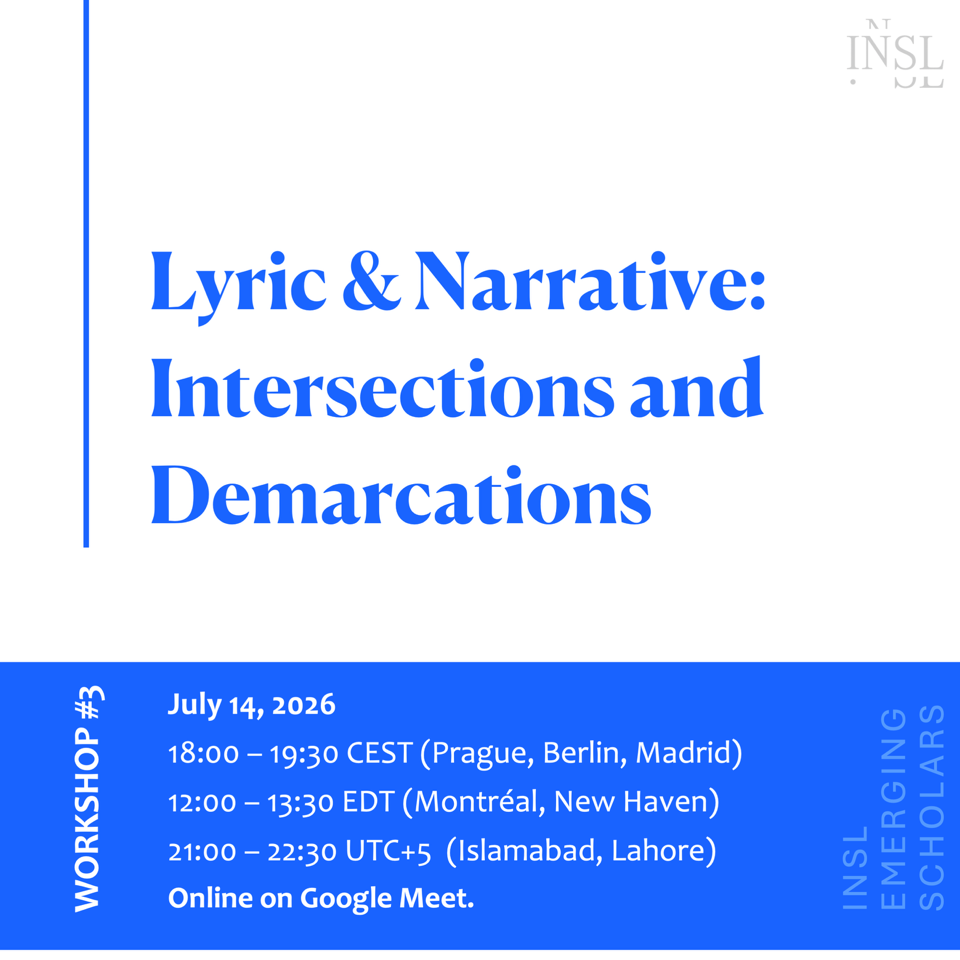
Workshop #3: “Lyric & Narrative: Intersections and Demarcations”, July 14, 2026
On July 14th the Emerging Scholars held their third online workshop “Lyric & Narrative: Intersections and Demarcations”, organised by Friederike Foedtke, Anna Jurgan, Adela Sophia Sabban, and Johanna Witzenrath. The workshop aimed to approach the theme of the 2027 INSL conference, “Lyric / Narrative: Crossings, Tensions, Reconfigurations” in a stimulating and open setting, and to provide an opportunity for participants to discuss their research projects related to the topic. Jonathan Culler’s article “Narrative Theory and the Lyric” (The Cambridge Companion to Narrative Theory, 2018) served as the basis for a discussion about aspects such as lyric as genre or mode, approaches combining narratology and lyric theory, and worldmaking in narration and lyric. The discussion also explored how temporality and the presence of a speaker/narrator are related to our conception of poetry and narrative. Examining two texts by Monika Rinck and Claire Lejeune, we reflected on how reading expectations and conventions influence our categorization of a text as lyric poem or narrative text. Finally, we exchanged ideas about potential topics for talks and panels at the conference.
Anna Jurgan (Berlin), Adela Sophia Sabban (Fribourg), and Johanna Witzenrath (Hamburg)

Salon #2: “Voices, Versions, Variants”, May 15, 2026
On May 15th, 2026, the Emerging Scholars held their second online salon, titled “Voices, Versions, Variants”. This edition, organized by Adela Sophia Sabban, Friederike Foedtke and Leira Araújo Nieto, was dedicated to poetry translation and practices of rewriting poems. Participants shared a selection of texts from various traditions and periods, and the discussion touched upon questions such as: How can ambiguity be reconstructed in a different language, and what possibilities do different languages offer for preserving or generating ambiguity? Does translation affect the notion of temporality in the poem?
Another part of the dialogue focused on the degree of freedom translators have and on editorial intervention in the translation process. Furthermore, the political implications of poetry translation were also addressed, particularly regarding how our perspectives on certain works change over time in response to evolving sociocultural frameworks. In this context, participants also discussed the potential of recombining poetic texts in order to reframe them and generate new perspectives.
Finally, the workshop considered not only linguistic forms of translation but also intermedial approaches to translating poems. More specifically, the genre of technopoetry—a form of performance combining techno music and poetry reading—was discussed, with Elsye Suquilanda’s Transición de Cenicienta de Späti (2015) serving as an example.
Friederike Foedtke (Salamanca) and Adela Sophia Sabban (Fribourg)
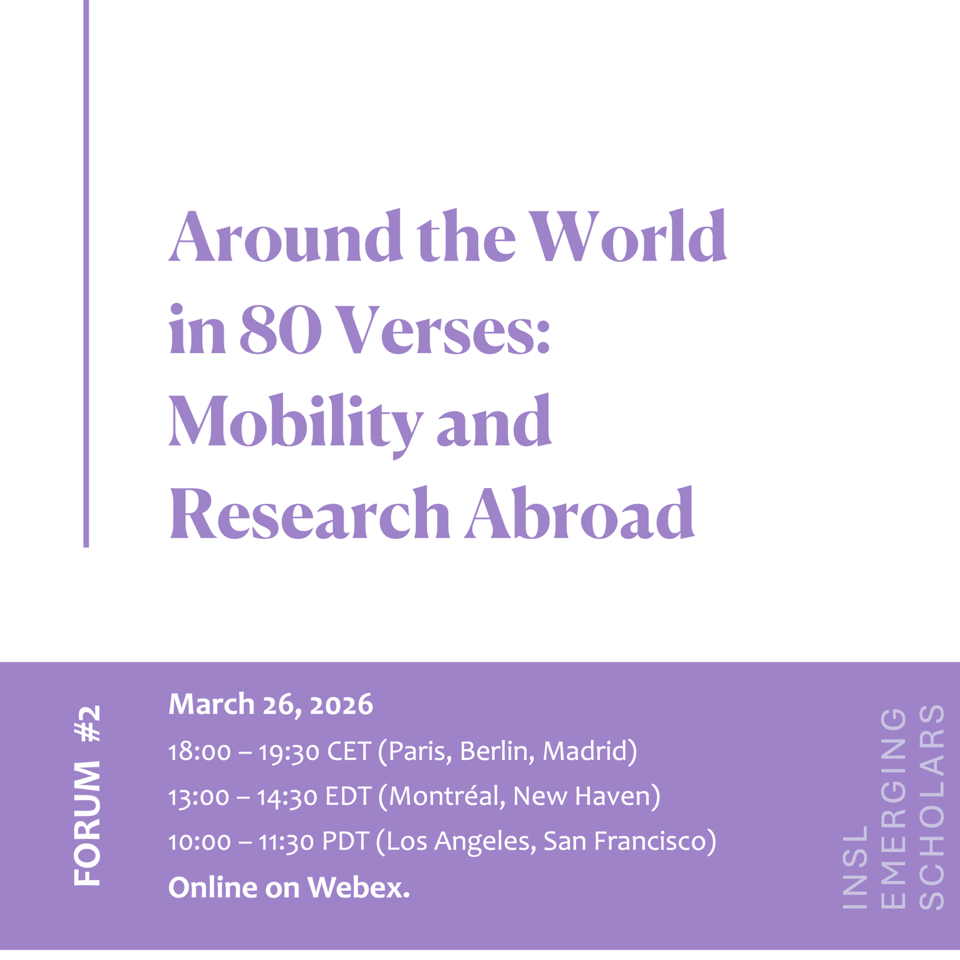
Forum #2: “Around the World in 80 Verses: Mobility and Research Abroad”, March 26, 2026
On March 26 2026, the INSL Emerging Scholars held their second online forum, dedicated to the topic of organizing and conducting research stays. The forum was organised by João Henrique da Costa Sol Afonso, Friederike Foedtke and Adela Sophia Sabban. The three organisers, as well as Eliška Dana Mikeschová and Anna Jurgan, shared their experiences of organising research stays abroad and in archives. We identified three types of research stays, which we then discussed:
In the case of those aimed at empirical fieldwork, the importance of beginning to plan as early as possible was stressed. Additionally, it can be helpful to integrate them into the design of the dissertation project. Taking these two measures can improve the chances of securing institutional or third-party funding.
Regarding stays at literary archives and libraries, a variety of organizational aspects were addressed, especially concerning the materials and tools available at the host institution. Equally crucial is to take into account any specific rules that may apply when working with archival materials, as well as the archive’s schedule, in order to avoid any restrictions due to staff vacations. Some fellowship programmes offered by some major libraries (e.g. Staatsbibliothek zu Berlin, Bibliothèque Nationale de France) and literary archives (such as the Deutsches Literaturarchiv Marbach) were also part of the conversations.
Finally, we spoke about research stays supervised by researchers at universities abroad. Topics of discussion included strategies for integrating oneself and one’s project into a new research context, meeting colleagues, and maintaining contacts after the research stay. Some participants highlighted the difficulty of finding potential hosts who work on related topics and are willing to accept visiting doctoral students. In collaboration with the Executive Board of the INSL, the Emerging Scholars plan to design a survey in the coming months that could help match doctoral students with more advanced researchers within the INSL—participation in the survey will be greatly appreciated!
Friederike Foedtke (Salamanca) and Adela Sophia Sabban (Fribourg)
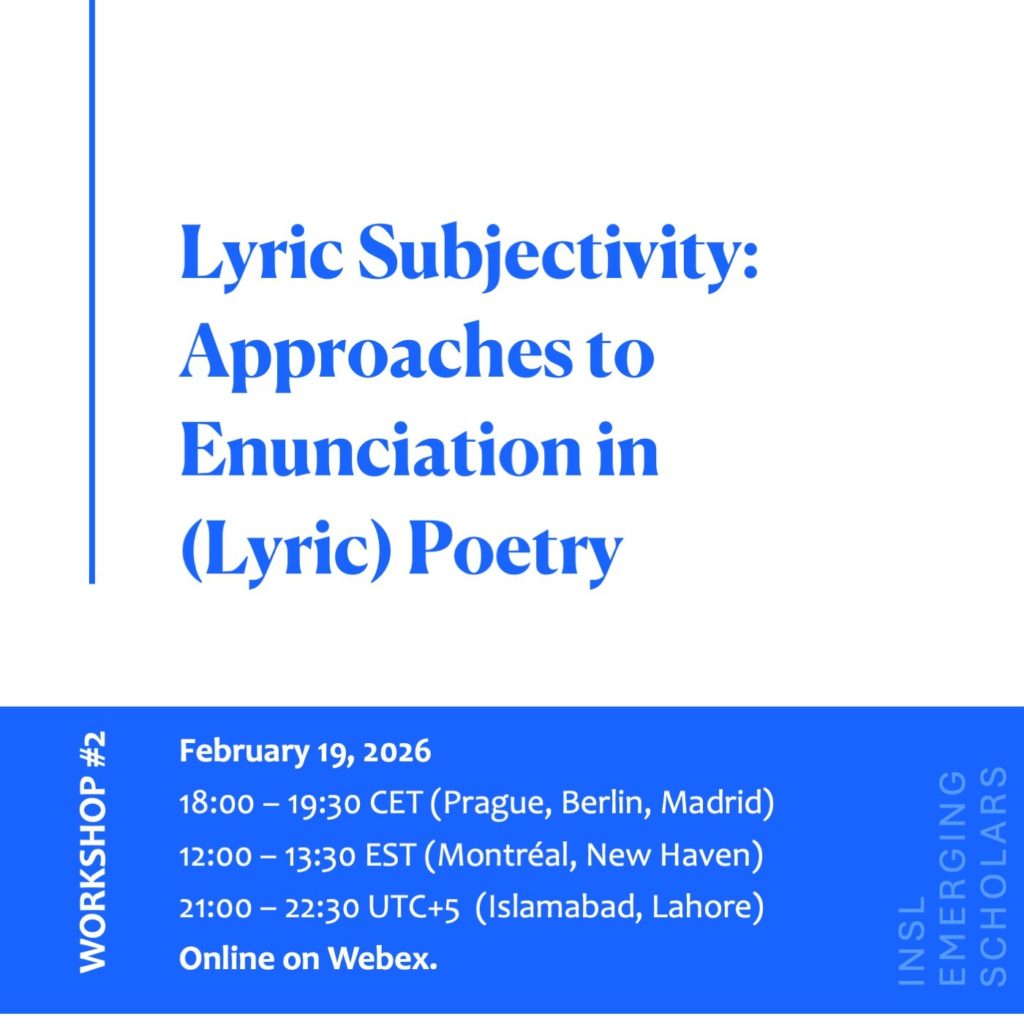
Workshop #2: “Lyric Subjectivity: Approaches to Enunciation in (Lyric) Poetry”, February 19, 2026
The second online workshop, held on 19 February 2026, focused on the topic of lyric subjectivity. The session was prepared by Friederike Foedtke, Luis García‑Vela, Marianne Godard, Adela Sophia Sabban, and Johanna Witzenrath. The discussion centred on fundamental questions such as: Who speaks (in) the poem? How should the lyric subject be defined? Should it be understood as a stable presence or as a dynamic configuration? What role do historical and textual variations play in theories of lyric subjectivity?
A central aspect of the workshop was the exchange between different academic traditions and philological approaches, particularly regarding how the relationship between author and speaker is conceptualised. In this context, the dependence of literary theory on historical frames and cultural contexts became also noticeable. We also addressed the question of how lyric poetry is positioned between fiction and non‑fiction.
Participants noted that lyric subjectivity constitutes a distinct form of subjectivity compared to other discursive contexts. However, other disciplines still have a potential to contribute to the study of lyric by proposing theories about the concept of the self and other relevant notions, such as inter- or transsubjectivity. Another aspect of discussion was the role played by the notion of a reader in frameworks of lyric subjectivity. Another aspect of discussion was the role played by the notion of a reader in frameworks of lyric subjectivity. The group discussed what happens to the notion of the speaker when a poem is read aloud by someone, as opposed to when it is silently read by an individual reader.
Through a fruitful dialogue between theoretical positions and philological traditions, the workshop highlighted the range of methodological approaches through which the central questions of lyric subjectivity are articulated and theorised.
Friederike Foedtke (Salamanca) and Adela Sophia Sabban (Fribourg)
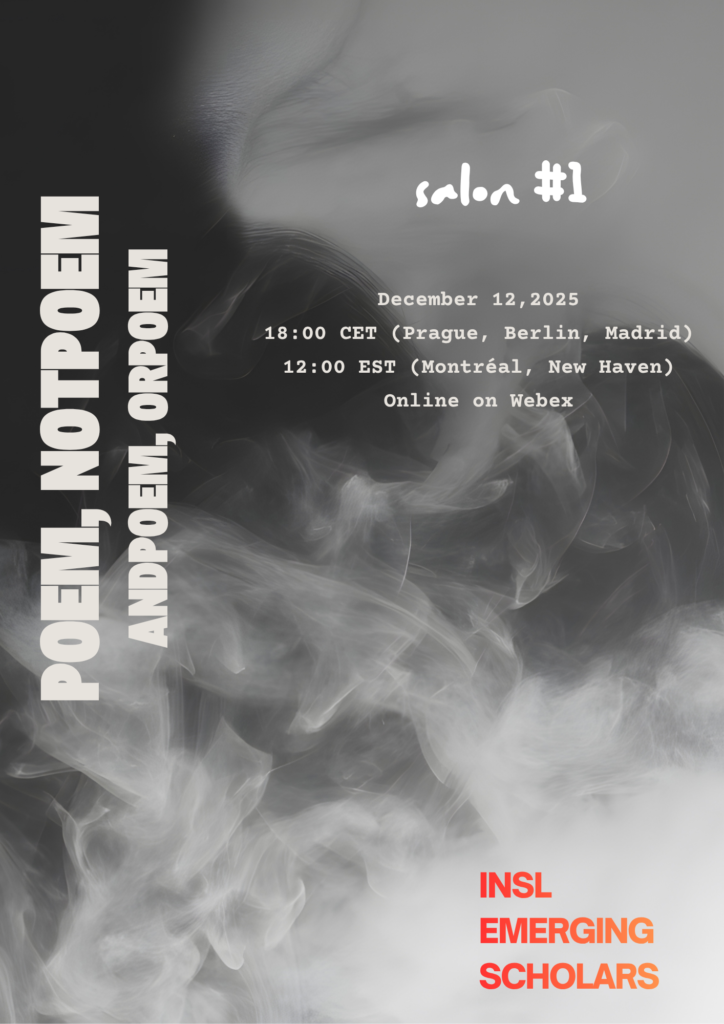
Salon #1: “POEM, NOTPOEM, ANDPOEM, ORPOEM”, December 12, 2025
On December 12th, 2025, we hosted our first salon as INSL Emerging Scholars with the title: “POEM, NOTPOEM, ANDPOEM, ORPOEM”. The aim of this online creative meeting was to share texts that we enjoy and that don’t require further academic examination. We wanted to focus on books or fragments that impel us towards artistic and philosophical paths.
Even though we planned to hold a 1–1.5 hour session, we extended it to almost 2 hours due to the amazing insights, connections and dialogues that were established following the presentation of our “literary artifacts”. Regarding them, it was not mandatory to share anything – it was possible to just attend the salon – but we enjoyed 5 texts during the gathering: poems, translations, a curious illustration and a philosophical/lyrical combo, which led to discussions about topics such as beauty, death, implications of several materialities of writing for the creative process and the potential of translation to present/think a text from a different perspective and a different system of thought. It was also suggested that due to our common interests, this format of “salons” could be a great opportunity to talk about poetry translation. This type of encounters offers the INSL Emerging Scholars a space for giving, sharing and nurturing ideas.
Leira Araújo-Nieto (University of Granada)
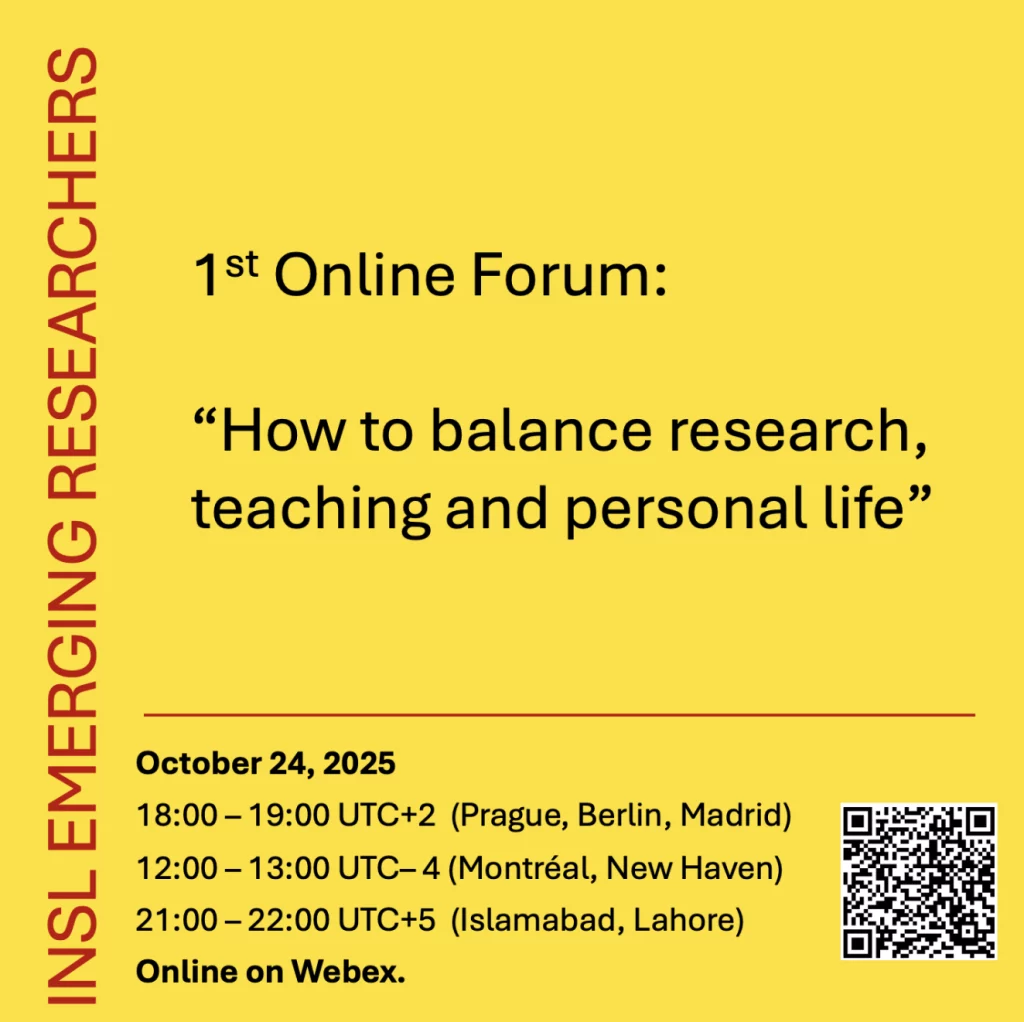
Forum #1: “How to Balance Research, Teaching, and Personal Life”, October 24, 2025
On October 24th, 2025, we hosted our first online forum, centered around the theme: “How to Balance Research, Teaching, and Personal Life.” As we explored the concept of “balance,” we questioned whether this concern is unique to our generation—perhaps one that earlier generations approached differently or didn’t articulate in the same way. We also acknowledged that “balance” is a deeply personal notion, varying from one individual to another. Our discussion touched on the time demands of teaching, the effort required for preparation, and what an ideal amount of prep time might look like. One key insight was that genuine enjoyment of our work is essential—without it, many of us might not have chosen academia in the first place. We also observed that the nature of assistant positions differs across countries.
Friederike Foedtke (Salamanca) and Adela Sophia Sabban (Fribourg)
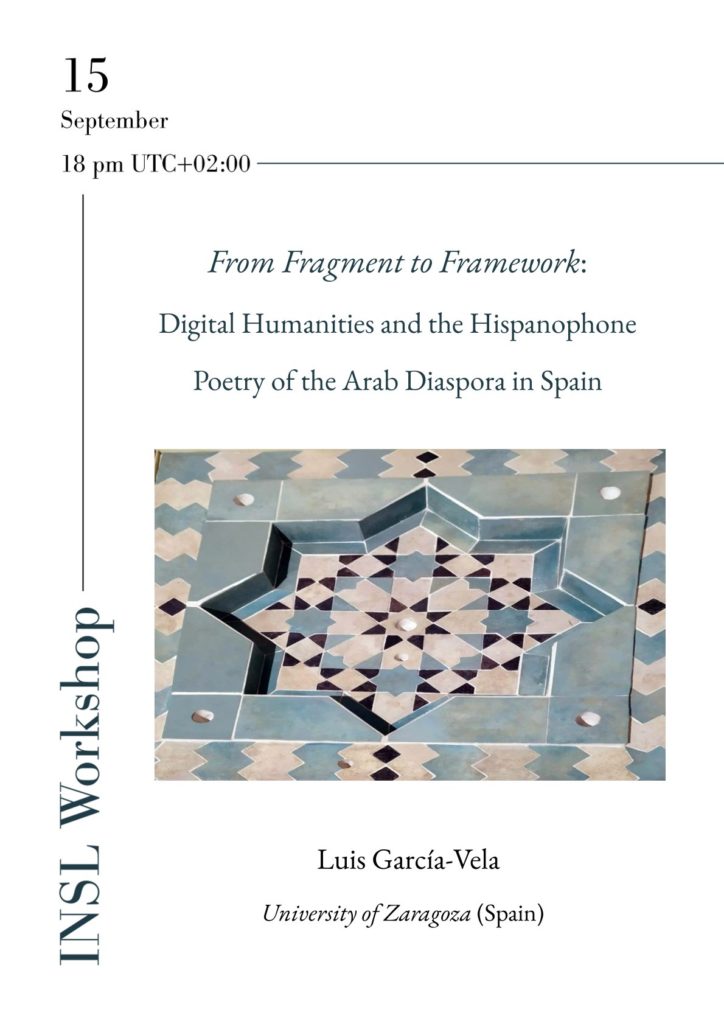
Workshop #1: “From Fragment to Framework”, September 15, 2025
Our first online workshop, entitled From Fragment to Framework: Digital Humanities and the Hispanophone Poetry of the Arab Diaspora, took place on September 15th, 2025. The topic for discussion was proposed by Luis García Vela (University of Zaragoza / University of Granada). Luis discussed the unstable and fragile position of Spanish poetry written by the Arab diaspora, which has not been extensively explored so far. He presented three anthologies: Siete Poetas Árabes Actuales en España (ed. José Sarria, 2013), Escribir con eñe. Otros poetas en español (ed. Hadi Sadoun, 2023) and Matria Poética. Una antología de poetas migrantes (ed. Hadi Sadoun). As indicated by terms such as “migrant” or “other” literature, one problem that affects the theoretical reflection of this type of literature is the absence of terminology.
Luis examined the use of the terms migrant and diaspora literature, which are questionable because they are too closely associated with looking back at the homeland. He also presented his corpus of Arabic poetry written in Spanish as part of the CoPoHiM project (Corpus de Poesía Hispanomagrebí; Corpus of Hispanophone-Maghrebi Poetry). An essential part of Luis’s work is mapping published poetry collections, which are often self-published. The visual presentation of the corpus was impressive, with a map showing the frequency of publications over time and their occurrence in different parts of Spain, North Africa, the Arabian Peninsula, South America, and other parts of the world.
Eliška Dana Härtelová (Charles University Prague)